Old Math Isn't Wrong. It's Just Not Enough Anymore.
Why procedural fluency still matters, why it isn’t enough on its own, and what parents should actually look for in their child’s math.
A parent shows me their kid's homework. Boxes and circles and "number bonds" where they expected columns and carrying. They want to help. They can't. They've spent the last twenty minutes trying to figure out what the question is even asking, and they're left wondering whether the new way is real progress or just educational fashion.
That's the most common version of a quiet worry I hear from parents. There are others. The kid is doing fine on tests but can't really explain the answers. Or they solve a problem one week and look at the same kind of problem the next week like it's the first time they've seen it. The grades say everything is fine. The parent's gut says it isn't.
I've been teaching math for 13 years and worked with over 2,000 students. I want to offer a way of thinking about this that I think is more useful than "the old way vs the new way."
What old math actually does well
Let's start with something the critics of traditional math get wrong.
The old way — procedures, algorithms, "carry the one," times tables drilled until they're automatic — is genuinely good. Better than it gets credit for in current education discourse.
When a kid practices long multiplication enough times to do it without thinking, something important happens in their brain. The procedure compresses. It stops taking up working memory. And once it's compressed, the brain has room to notice things — patterns, shortcuts, why certain steps work the way they do.
Fluency isn't the opposite of understanding. It's often a precondition for it.
A child who can compute 7 × 8 instantly has mental space to wonder why 7 × 8 and 8 × 7 give the same answer. A child who's still counting on their fingers doesn't get that far. They're too busy surviving the problem.
This is why I get nervous when people dismiss "drill and kill" as outdated. Practice that builds fluency is doing real cognitive work, even when it looks mechanical from the outside. The traditional curriculum understood this. It earned its place.
So what's the problem?
The problem isn't the math. It's the signal.
Schools tell kids — through grades, through timed tests, through the way teachers respond — that being fast and accurate is the goal. Get 90% or higher, get praised. Finish first, get noticed. Procedural mastery becomes the destination instead of the foundation.
Kids are smart. They optimize for what gets rewarded. So they learn the algorithm, hit 95% on the test, and conclude they're good at math.
They aren't wrong, exactly. They've achieved something real. But they've also been taught — implicitly, through years of feedback — that this is what math is. That the work is done. That getting the right answer quickly is the whole game.
It isn't.
The second layer
There's another layer of math that most kids never get to. Not because they aren't capable, but because nothing in their schooling pushes them past the first one.
The second layer is about seeing structure. It's noticing that the same idea shows up in different costumes. That fractions, ratios, slopes, and rates of change are all expressions of the same underlying idea — proportion. That when a problem changes its surface, something underneath stays the same — and that something is what mathematics is actually about.
The second layer is asking: what's invariant here? When I scale this triangle up, what stays the same? When I rearrange this equation, what hasn't changed? When this word problem becomes a different word problem with the same numbers, why does the answer change in a predictable way?
This is the part of math that compounds. Every connection you make becomes a hook for the next idea. Kids who develop this kind of thinking find that algebra, geometry, and calculus aren't separate subjects to be conquered one at a time — they're variations on themes they already recognize.
Kids who stay in the first layer experience each new topic as a new procedure to memorize. The workload grows every year. The connections don't.
Why this matters more now than it used to
Here's the part that should keep parents up at night.
The traditional math curriculum was designed for a world where computational fluency was economically valuable. Two generations ago, being able to do arithmetic quickly and accurately was a real job skill. Banks needed it. Engineers needed it. The kid who could compute fast had a meaningful advantage in adult life.
Calculators changed that. AI is changing it again, much faster and much more deeply.
Your child has tools in their pocket right now that can solve any procedural problem in their textbook. Not just arithmetic — algebra, calculus, statistics, all of it. The procedural layer of math, the thing schools have been optimizing kids for, is being commoditized in real time.
This does not mean math is becoming useless. It means the valuable part of math is shifting. Hard.
The kids who will thrive in this world aren't the ones who can do procedures faster than a machine. That race isn't the one worth running. The kids who will thrive are the ones who can recognize when a real-life situation has mathematical structure underneath. Who can frame a messy problem in a way that math can attack. Who can look at an answer — their own, or one an AI gave them — and tell whether it's right.
That last one is the quiet crisis. AI gives confident answers whether it's right or wrong. A student without strong mathematical intuition can't tell the difference. They accept whatever sounds plausible. A student with strong intuition can interrogate it, push back, redirect.
The first kind of student becomes a consumer of AI. The second kind becomes a user of it. The gap between those two is going to define a lot of futures.
What this means for parents
I'm not asking anyone to throw out the traditional approach. I meant what I said earlier — fluency matters, and the old curriculum builds it.
What I am saying is that procedural mastery is the floor, not the ceiling. If your child gets 95% on a timed multiplication test and the math education stops there, an important part of the job has been done. But not the whole job. And report cards aren't going to tell you the difference.
So the questions worth asking about your child's math experience are different from the ones report cards answer.
Does your child notice when two problems are the same problem in disguise? Can they look at their own answer and tell if it makes sense, before checking the back of the book? When they get something wrong, can they figure out why, or do they just try again hoping for a different result? Are they ever asked to explain their reasoning out loud, or only to produce a final number? When they see math in the real world — a tip at a restaurant, a sale price, a sports statistic — do they reach for it, or freeze?
These are second-layer signals. They're harder to grade and harder to test. They're rarely what gets rewarded at school. But they're what separates kids who survive math from kids who use it.
The PrepBox way
Some kids develop both layers together. They drill their times tables and you can see the structural insight start to bloom on its own — oh, 9 × 7 is just 10 × 7 minus 7. The fluency pulls the thinking behind it, naturally.
Other kids develop them separately. The fluency comes first and the structural understanding has to be deliberately taught, with bar models and visual reasoning, on top of a solid procedural floor. Or the opposite — the kid is intuitive about structure but freezes at the arithmetic, and the foundation has to be quietly filled in underneath so the conceptual work stops eating their bandwidth.
The mistake is to assume every kid is the first kind and panic when they aren't. Or to assume every kid is the second kind and try to teach structure on top of a foundation that hasn't been built. Both moves leave kids stranded.
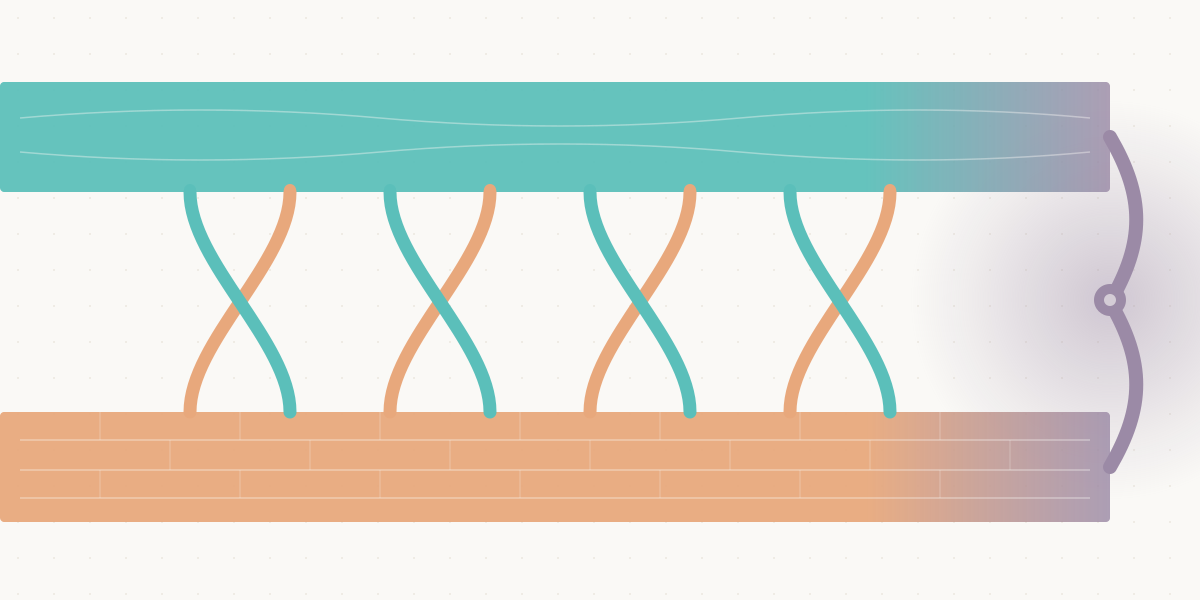
The PrepBox way is to refuse to pick. We respect both layers as real, and we track both, always. Procedural fluency we measure through stroke-level data — how fast a kid writes, how often they erase, how confident each mark looks. Structural understanding we measure through which questions they can connect, which prerequisites are missing, where the same idea keeps showing up in their mistakes.
So when your child gets stuck, we're not guessing whether the problem is fluency or thinking. We can see which one is missing, and put the time there.
The honest answer
The old way is good. It builds something real. The parents who defend it aren't wrong.
But it was designed for a different world. A world where being a reliable human calculator was a meaningful skill. We don't live there anymore, and our children definitely won't.
The newer approaches — number bonds, visual models, multiple strategies for the same problem — aren't replacing the old way. At their best, they're trying to plant the second layer earlier. To show kids that numbers have structure you can see and manipulate, that there are many paths to the same answer, that math is something you think with and not just something you perform.
When this works, kids end up with both. Procedural fluency and structural intuition. The floor and the ceiling.
When it doesn't work — when the second layer is pushed before the first is solid, or when the new strategies become their own kind of empty performance — we get the worst of both worlds. Kids who can't compute and can't think.
So the real question for parents isn't "old way or new way." It's whether we're willing to ask more of math education than we used to. Whether we accept that "my kid gets 90% on the test" is a beginning rather than a destination. Whether we're preparing children for the world we grew up in, or the one they're actually going to live in.
The old way got us this far. It won't get our kids the rest of the way.
That's not a criticism of the old way. It's just the truth about where we are.
— Min Founder, PrepBox