Why Reverse Percentage Problems Feel Like a New Skill—and Why They Aren't
Finding a sale price and rebuilding the original price are the same relationship viewed from opposite ends.
I can usually tell when percentages have been taught as a collection of procedures.
I give a student this question: a jacket costs $80 and is discounted by 25%. What is the sale price? The student responds quickly. They multiply by 0.75 and get $60.
Then I turn the same relationship around: a jacket costs $60 after a 25% discount. What was the original price?
The pencil stops.
Nothing important about the situation has changed. The same jacket, the same discount and the same two prices are still there. But to a student who learned the first question as a sequence of steps, the second question looks like a new species of problem. The familiar procedure points in the wrong direction, so they wait for another one.
This is why reverse percentage problems feel harder than they are. Students are often taught to recognize two surface patterns:
“Find the sale price” means multiply by 0.75.
“Find the original price” means divide by 0.75.
Both procedures are correct. A fluent student should eventually be able to use them. The problem is what happens when the procedures arrive before the relationship they describe. The student has to remember which operation belongs to which wording, and a small change in the question can make the whole method feel unfamiliar.
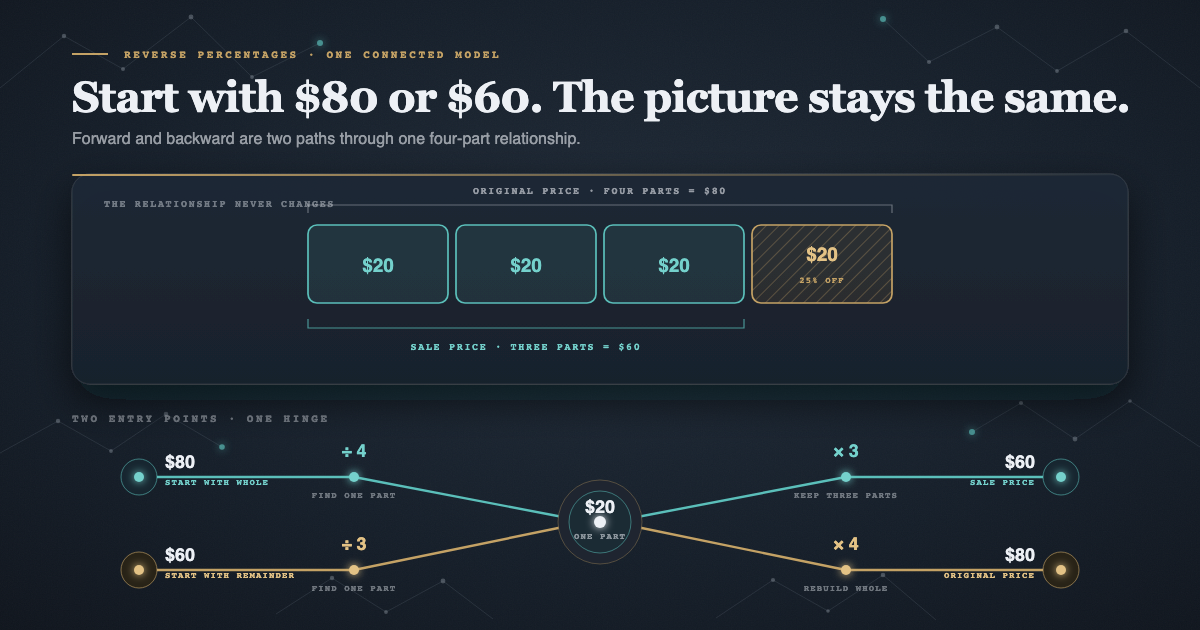
Now draw the original $80 as four equal boxes:
[ $20 ][ $20 ][ $20 ][ $20 ]
Twenty-five percent means one quarter, so the discount removes one of the four boxes. Three boxes remain:
[ $20 ][ $20 ][ $20 ] = $60
If the original price is known, the student divides $80 into four equal parts and keeps three. That gives the sale price: $60.
If the sale price is known, the student sees that $60 represents the three remaining parts. Divide $60 by three to find one part, then rebuild all four. That gives the original price: $80.
The picture does not change. Only the place where we enter it changes.
A procedure remembers the direction. A model lets the student rebuild it.
This is the difference between memorizing two percentage rules and building one connected mathematical idea. In the first version, “multiply by 0.75” and “divide by 0.75” can live like separate sticky notes in the student's memory. In the second, both operations emerge from the same four-part structure.
The model also explains where 0.75 comes from. After a 25% discount, 75% remains. Seventy-five percent is three quarters, which is why the three boxes are still present. Multiplying by 0.75 is not an arbitrary button to press; it is a compact way of taking three of four equal parts.
Dividing by 0.75 reverses that relationship. If $60 is three quarters of the whole, dividing by three finds one quarter and multiplying by four rebuilds the whole. The decimal procedure is simply a compressed version of the visual reasoning.
That matters because percent is not really an isolated chapter. This one picture connects percentage to fractions, equal sharing, division, multiplication, ratio and proportional reasoning. When those connections are visible, a student is not adding another rule to a list. They are strengthening several parts of their internal math graph at once.
The same structure works when the numbers change. A 20% discount can be pictured as five equal parts with one removed and four remaining. If the price after the discount is known, those four remaining parts can be used to rebuild all five. A 30% discount leaves 70% of the original; the student can reason from 70 parts back to 100. The arithmetic becomes less tidy, but the relationship remains stable.
This is what a useful mental model does. It survives changes in direction, wording and numbers. It gives the student somewhere to reason from when memory fails.
That does not make practice unnecessary. Students still need enough fluency to divide, multiply and move comfortably between fractions, decimals and percentages. Drilling is the foundation, but it is not the building. Practice should make the connected idea easier to use; it should not replace the connected idea.
This is also why a correct answer tells us less than we often assume. Two students can both produce $80. One recognized the phrase “original price” and retrieved a rule. The other understood that $60 represented three equal parts and reconstructed the fourth. The answers match, but the learning underneath them is different. I wrote more about that distinction in Conceptual Understanding vs Procedural Fluency.
The difference becomes most visible when the problem changes again. Ask for the price before a percentage increase instead of a discount. Change 25% to 15%. Remove the familiar shopping language. A memorized procedure may need a new cue. A connected model can be adjusted because the student knows what the quantities represent.
That ability matters more as calculation becomes easier to outsource. A tool can multiply or divide by 0.75 instantly. The valuable human part is knowing whether 0.75 represents what remains or what was removed, deciding whether multiplication or division matches the direction of the question, and recognizing when an answer is unreasonable. Calculation produces a number. Understanding tells us whether it belongs.
This is what we mean when we say math is a graph, not a list. A new skill should attach to earlier knowledge and make the whole network easier to navigate. When percent reconnects to fractions and division, the student gains more than a faster way to solve discount questions. They gain a structure they can reuse.
Parents should not have to diagnose whether that structure exists by watching over homework. Ask the program or tutor one concrete question instead: Can you show me how one visual model solves the same percentage problem both forward and backward?