I Was a Math Champion. I Was Also Memorizing More Than I Understood.
A correct answer can hide the difference between knowing a procedure and understanding what sits beneath it.
I was the math competition champion at my school. I won medals and recognition. I was quick, accurate, and very good at seeing a familiar pattern inside an unfamiliar-looking question. My method was simple: identify the problem type, retrieve the matching procedure, and execute faster than everyone else.
That was not fake learning. Procedural fluency and pattern recognition are real skills. Both took work and carried me a long way. But I was collecting mathematical tools faster than I was building the structure needed to judge them.
Most adults were taught math similarly. A teacher demonstrated a rule. We practised until the steps became familiar. Then the test gave us questions that looked enough like the examples for the rule to work. If we succeeded, we called that understanding.
This is one reason so many capable adults remember math as a pile of disconnected instructions. Move this number to the other side. Invert and multiply. Use this formula when the question contains these words. The procedures may have been correct, but the connections underneath them were rarely made visible. Years later, the instructions disappeared because there was no larger structure holding them together.
There is a difference between having a mathematical skill and having the understanding beneath that skill.
The skill lets a child carry out a method and recognize situations where it has worked before. The understanding beneath it lets the child explain why the method works, compare it with another approach, notice the assumptions it depends on, and reshape it when the problem changes. It gives the child an internal map instead of a larger collection of directions.
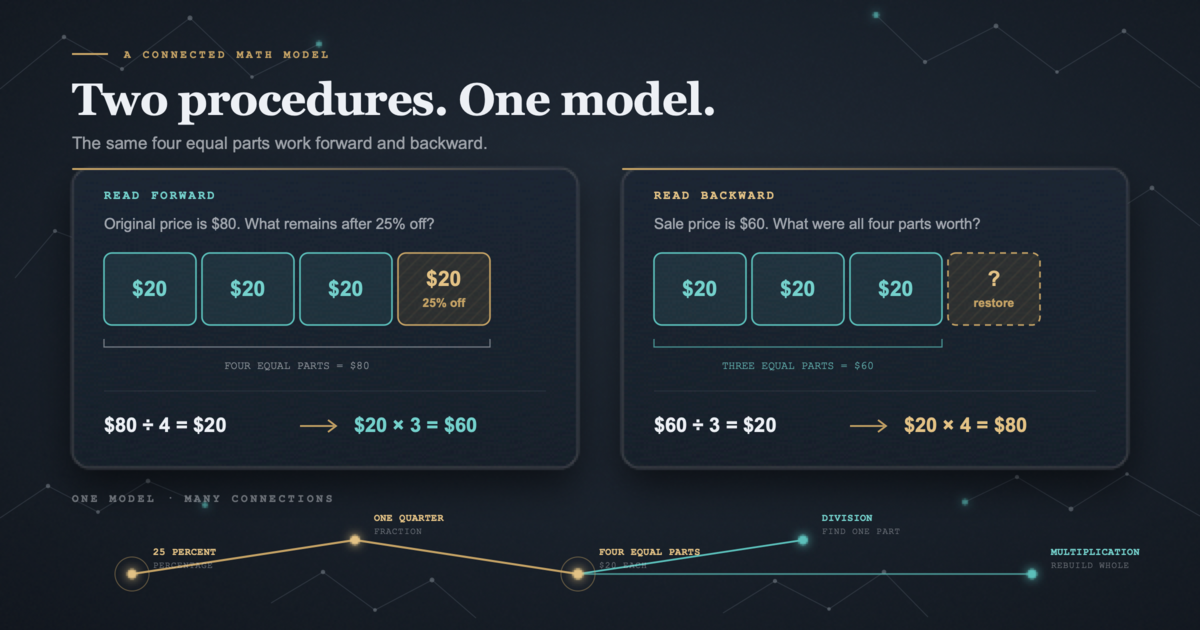
Take a familiar question: a jacket costs $80 and is discounted by 25%. A practised student may recognize the type, multiply by 0.75, and get $60. Now reverse it: after a 25% discount, the jacket costs $60; what was its original price? These are the same percentage relationship viewed from opposite ends. Taught procedurally, they can feel like two separate problem types. One means multiply by 0.75. The other means divide by 0.75. A student may need separate instruction and practice before recognizing each pattern.
But draw the relationship as four equal boxes and the two questions become one idea. The four boxes represent the original price. A 25% discount removes one box, leaving three. If all four boxes are worth $80, each box is worth $20, so the remaining three are worth $60. If instead we start by knowing the three remaining boxes are worth $60, each is still worth $20, so all four must be worth $80.
Nothing about the model changes when the direction of the question changes. The child is not retrieving a second procedure; they are moving around inside the same picture. Procedurally, these look like two skills. Structurally, they are one relationship viewed from opposite ends.
The picture also connects percent back to ideas the child already knows. Twenty-five percent is one quarter, so the discount is one of four equal parts. Finding the value of one box is division. Rebuilding the whole is multiplication. Percent is no longer an isolated chapter with its own collection of rules; it becomes an application of fractions, division, and multiplicative relationships.
This is how a math graph forms instead of a list of isolated skills in a child's head. Each new idea attaches to ideas that are already there, so the map becomes more useful as it grows. Learning procedures in isolation does the opposite. It leaves the child carrying a collection of mental sticky notes — one for each recognizable question pattern — with no reliable way to navigate when a problem does not match one exactly.
That map lets a student ask better questions. Would this still work if the number were negative? Is this answer reasonable? These are not decorations added after the “real math” is finished. They are what turns a procedure into something a person can think with.
The right answer is evidence that a procedure worked once. It is not proof that understanding was built.
Practice still matters. Fluency in basic facts creates room for larger ideas. The mistake is treating fluency as the destination rather than the capacity for deeper thinking.
AI can already carry out procedures, retrieve formulas, and recognize familiar patterns at a scale no person can match. The layer being compressed is precisely the layer many of us were trained to mistake for mathematical ability.
That makes human understanding more valuable. A person with a strong internal map can use powerful tools without handing over judgment. They can frame the problem, compare approaches, question assumptions, and recognize when an elegant answer is wrong. Without that structure, the person becomes dependent on whatever answer arrives, unable to tell whether it fits or quietly answers the wrong question.
The difficult part is recognizing whether this internal graph is actually forming. That requires mathematical taste: seeing past the final answer into the representation a child chose, the earlier ideas they reached for, and what they did when a familiar procedure stopped working. It is the kind of expert noticing that defines strong teaching. A strong teacher or mentor can notice those things. It is hard-earned expertise, which is why it is both rare and expensive.
This is not a fair burden for parents. Many parents — and teachers — were taught through the same procedural system. If nobody showed you the difference, you cannot reliably detect it in someone else's work. A score or stack of completed worksheets will not solve that problem.
This is the mission behind PrepBox: make the evidence that expert educators look for visible at scale. Students still solve mathematics by hand on a tablet, but their stroke-level process — the order of the work, pauses, erasures, and revisions — can be preserved and analyzed instead of disappearing when the page is finished. Each question is also located inside an educator-built MathGraph with teacher-verified prerequisite connections. The graph shows where an idea belongs; the handwritten process shows how the student moved through it.
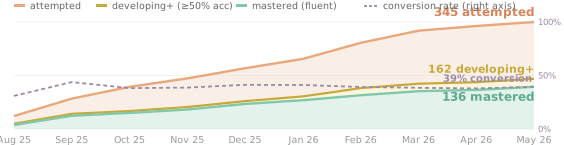
One anonymized Grade 7 student's real PrepBox history: 345 skills attempted, 162 developing, and 136 fluently mastered. The gap is the difference between material encountered and learning consolidated.
Neither layer is a mind reader. Together, they give a good educator a richer trail of evidence about whether a new skill is attaching to earlier knowledge or standing alone as another procedure. The technology does not replace the rare teacher who can see the difference. It helps that teacher's judgment reach more students, more consistently.
The practical question is not whether a child got it right today, but what evidence would show that the understanding survives when the problem changes or a month passes.
So do not turn tonight's homework into an examination you have to administer. Ask something of the program or tutor you are already paying: Show me one mathematical connection my child has built, and show me the evidence that tells you it is there.
Most programs cannot answer this because they were designed to record completion, not thinking.