How Can You Tell Whether a Child Really Understands Math?
A score shows what happened once. Understanding leaves a pattern that survives when the problem changes.
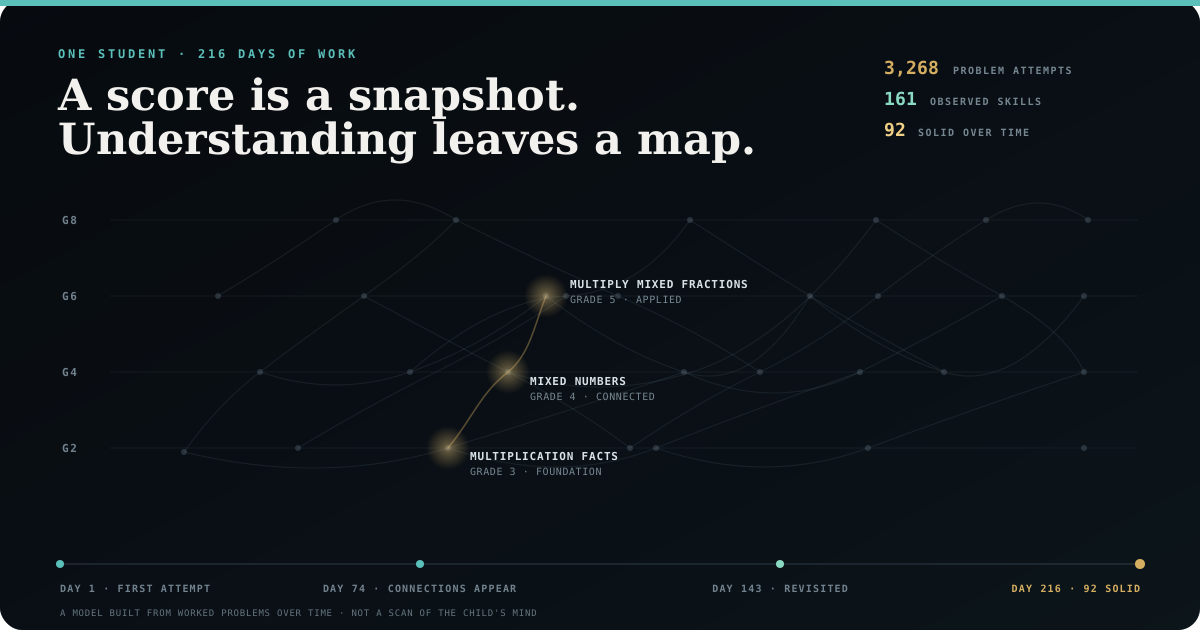
At the end of a tutoring session, a parent will often ask me a version of the same question: “Did she understand it?”
The easy answer is to look at the page. Eight questions correct out of ten. Homework finished. Fewer mistakes than last week. Those facts matter, but they do not answer the question the parent is really asking.
They want to know whether the idea belongs to their child now. Will she recognize it when the wording changes? Can she rebuild the method if she forgets a step? Will it still be there before the exam, or did it disappear as soon as the worksheet ended?
A score cannot tell us all of that because a score compresses the learning into one number. It records what happened at the end, not what the student understood underneath it.
This is why two students can produce the same correct answer and be in very different places. One student may recognize the surface pattern, retrieve a familiar procedure and execute it accurately. Another may see how the quantities relate, connect the problem to an earlier idea and choose a method because they understand why it fits. On that question, on that day, the work may look equally successful.
The difference appears when something changes.
Change the numbers so the arithmetic is less friendly. Turn the question around. Remove the familiar words. Ask for the same relationship in a diagram instead of an equation. Return to it three weeks later, after the rehearsal has faded. A procedure that was attached only to one recognizable pattern may stop. A connected idea can usually be rebuilt.
Understanding is not a result a child produces once. It is a pattern that survives change.
That pattern leaves evidence, but the evidence is spread across time and across different parts of the work. It appears in the representation the student chooses before calculating. It appears when they revise a diagram instead of abandoning the problem. It appears when a percentage question reconnects to fractions and division, or when an algebra mistake traces back to an earlier weakness with negative numbers. It appears when the student can return to an idea later without needing the entire lesson repeated.
No single signal proves understanding. A child who explains a method beautifully may still have rehearsed the explanation. A child who erases frequently may be confused, or may be checking their reasoning carefully. Fast work can mean fluency or guessing. Slow work can mean struggle or depth.
What matters is the pattern across signals. Did the child use the idea in more than one form? Did the method remain stable when the surface changed? Does the work connect to the prerequisites beneath it? Did the learning persist?
Seeing that pattern is the work of a strong teacher. It is the expert noticing that happens when a teacher catches what the final answer hides. It takes mathematical knowledge, experience with many students and enough attention to compare what is happening now with what happened before.
That is also why this should not become another job for parents.
Most parents were taught mathematics through procedures themselves. Even when they sense that something is missing, they may not have the language to distinguish a fragile method from a connected model. Asking them to sit beside the homework and invent follow-up questions is not a solution. If you do not know what evidence to look for, more observation only creates more anxiety.
The program should carry that responsibility. A good learning system should operate as a closed feedback loop. The student works. The program preserves enough of the process to interpret what happened. That interpretation changes what the student receives next. Later work then shows whether the change helped.
Most math programs leave this loop open. They assign questions, mark answers, record a percentage and move to the next skill. The score goes into a dashboard, but very little comes back out as a better decision for this child. Completion is recorded. Learning is assumed.
Closing the loop requires better evidence than a right-or-wrong total.
This is what we are building PrepBox to preserve. Students still solve mathematics by hand, but on a tablet the order of the work does not disappear when the page is finished. The strokes, pauses, erasures and revisions remain available as a process, not just a final image. Each question is also placed inside an educator-built MathGraph with teacher-verified prerequisite connections, so a mistake is not treated as an isolated event. It has a location and a history.
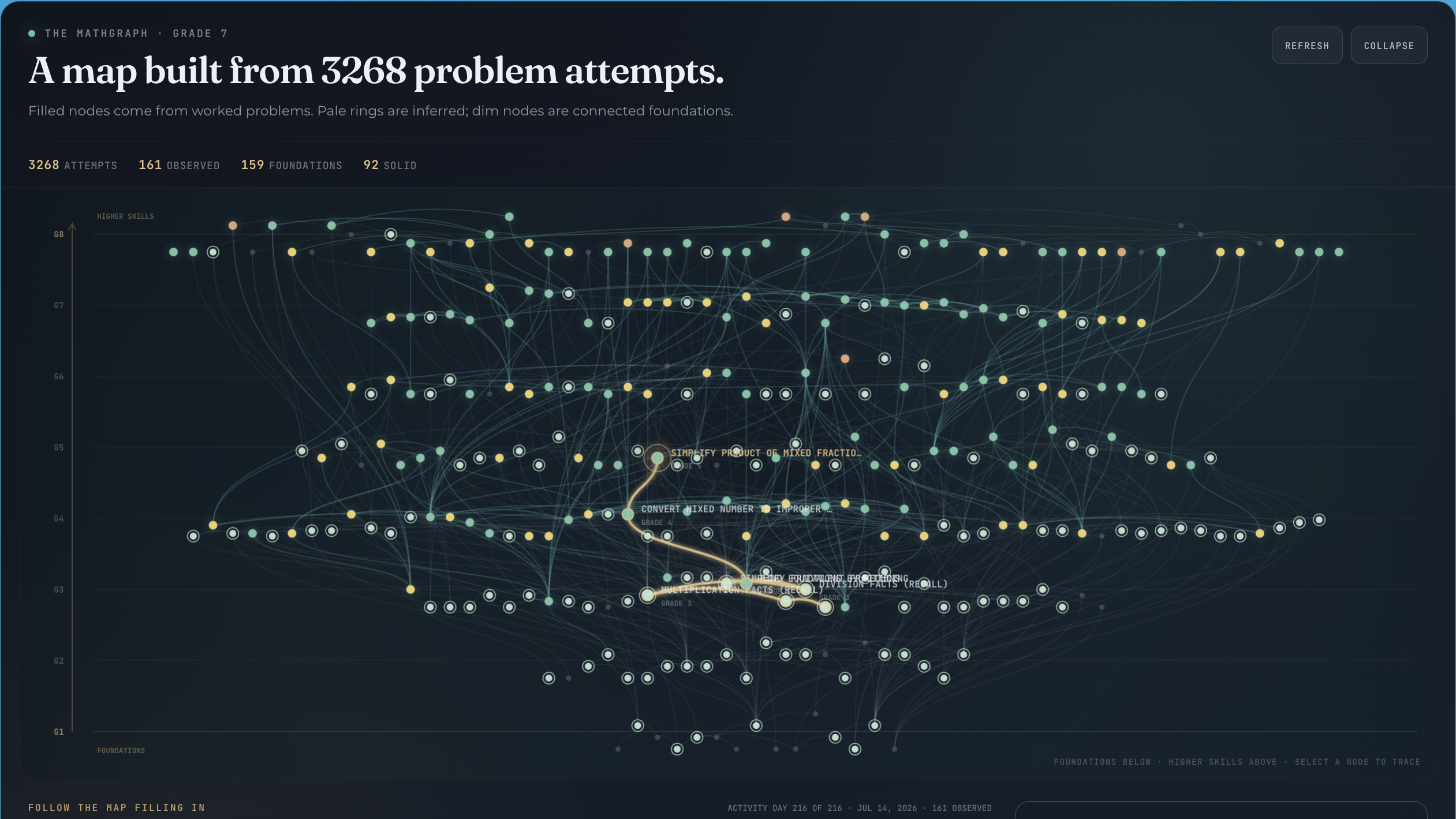
The handwriting alone is not enough, and the graph alone is not enough. Neither can read a child's mind. But together, across repeated attempts, they give an educator something much more useful than a score: a trail of evidence.
That trail can show whether a student is only succeeding when the wording is familiar. It can show whether exposure is turning into fluent mastery over time. It can show that the visible Grade 8 difficulty is resting on a Grade 5 prerequisite that never became stable. Most importantly, it gives the teacher a reason for what should happen next.
That final step is what makes the loop valuable. The purpose of evidence is not to produce a more impressive report. It is to make a better teaching decision.
This matters more as software becomes able to produce correct-looking mathematical work instantly. Producing an answer is becoming cheaper. Judging whether the method fits, whether the assumptions hold and whether the answer makes sense is becoming more valuable. Children need connected mathematical models they can think with, not just procedures they can reproduce until a machine reproduces them faster.
Parents do not need access to every data point behind that judgment. They need the program to turn the evidence into a clear answer: what is solid, what is fragile, what earlier idea is affecting the current work, and what will be done next.
So ask one question of the math program or tutor you are already paying: What evidence would show you that my child still understands this when the problem changes or a month passes?
A strong answer will not be another score. It will show you that someone is actually closing the loop.